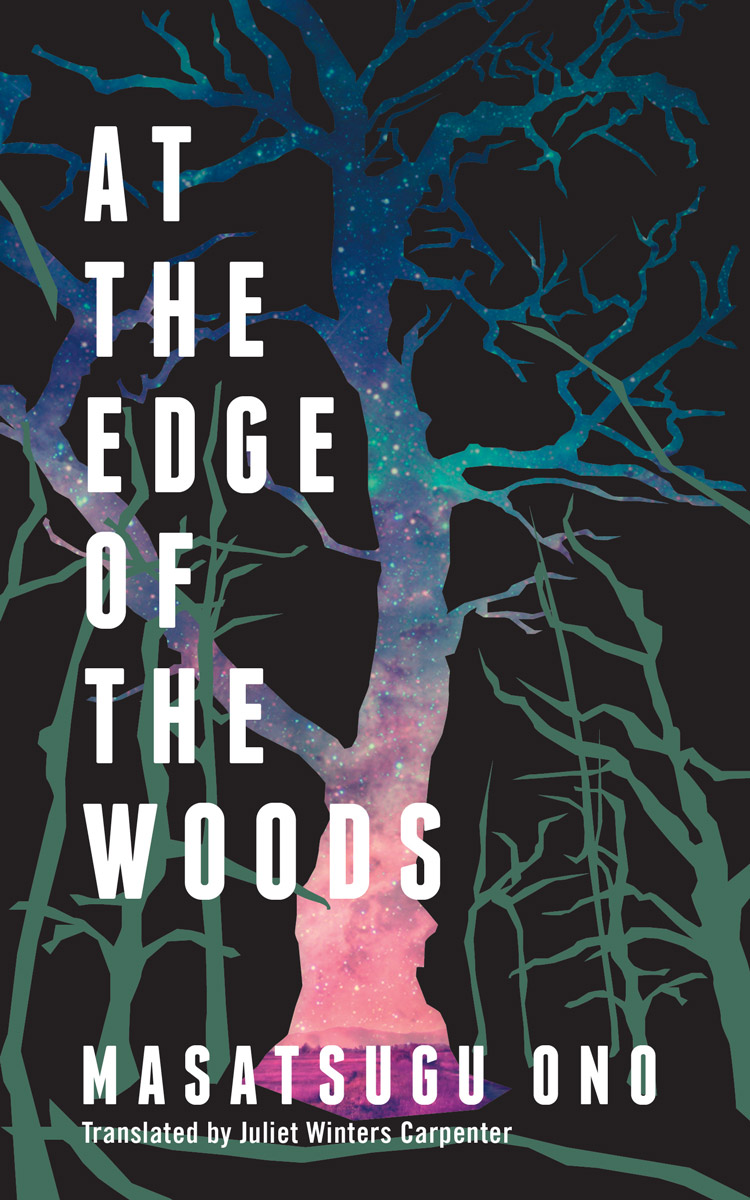
At the Edge of the Woods
$16.95
Additional Info
- ISBN: 9781949641288
- Size: 5" x 8"
- Pages: 184
- Publication Date: April 12, 2022
In an unnamed foreign country, a family of three is settling into a house at the edge of the woods. But something is off. A sound, at first like coughing and then like laughter, emanates from the nearby forest. An allegory for alienation and climate catastrophe unlike any other, At the Edge of the Woods is a psychological tale where myth and fantasy are not the dominion of childhood innocence but the poison fruit borne of the paranoia and violence of contemporary life.
“An eerie allegory of climate apocalypse and unnatural nature…full of dark laughter, figures that appear and disappear, sounds of violence and gnashing teeth.” —The Millions (Most Anticipated Books of 2022)
In an unnamed foreign country, a family of three is settling into a house at the edge of the woods. But something is off. A sound, at first like coughing and then like laughter, emanates from the nearby forest. Fantastical creatures, it is said, live out there in a castle where feudal lords reigned and Resistance fighters fell. When the mother, fearing another miscarriage, returns to her family’s home to give birth to a second child, father and son are left to their own devices in rural isolation. Haunted by the ever-present woods, they look on as the TV flashes with floods and processions of refugees. The boy brings a mysterious half-naked old woman home, but before the father can make sense of her presence, she disappears. A mail carrier with gnashing teeth visits to deliver nothing but gossip of violence. A tree stump in the yard refuses to die, no matter how generously the poison is applied.
An allegory for alienation and climate catastrophe unlike any other, At the Edge of the Woods is a psychological tale where myth and fantasy are not the dominion of childhood innocence but the poison fruit borne of the paranoia and violence of contemporary life.
Praise
“Ono’s immersive narrative accrues insights about the nature of violence and mercy…an accomplished work by a masterful writer.” —Publishers Weekly
“Like Murakami paying homage to Stephen King… It is with a sense of compelling unease that one wanders through the curious world of [Ono’s] novel.” —Litro Magazine
“Ono structures his novels like classical productions… The joy and surprise in his novels come from such play, such variations and how they are juxtaposed against and absorb that which is outside the norm, on the other side of the edges. At the Edge of the Woods is an excellent introduction to his work.” —The Rupture
“Enchanting and vividly terrifying… At The Edge of The Woods can only be read at the edge of your seat.” —International Examiner
“The terrors in Ono’s world seem unfamiliar and strange. Until they don’t. Like an image that slowly resolves into focus, the occasional appearance of people in unexpected places becomes a full blown refugee crisis like the ones that rock the contemporary world.” —Asian Review of Books
“[The novel] dares to question modernity… The woods become a metaphor for the aspects of nature that the modern man and woman can no longer accept. Humans always seek answers to every question, but what if there is no answer? There exists a deep chasm in our understanding, an emptiness that instinctually horrifies us. A void we must fill with ‘imps’ and ‘demons’ in order to justify our trepidation.” —Asia Media International
“A haunting fable about the disturbing strangeness of modern life… Some readers might think At the Edge of the Woods has perfectly captured the mood of the times.” —Shelf Awareness
“A surreal tale of a world torn apart by disaster… Written in startling, imaginative vignettes, At the Edge of the Woods is an evocative terrifying story about a family’s efforts to survive a crisis.” —Rebecca Hussey, Foreword Reviews
“Japan, of course, has a long tradition of ghostly stories, both in literature and cinema, and it is clear that Masatsugu Ono is well within this tradition. It certainly is a clever and well-written book and one thoroughly enjoyable to read.” —The Modern Novel
“At the Edge of the Woods balances wonder and disquiet with incomparable grace and precision; in this novel about a family navigating their unsteady future, Masatsugu Ono illustrates modern life’s horrors alongside the wonder of the unknown. Ono is one of our great chroniclers of love, with all of its possibility and dread, and the worlds this novel inhabits are both unsettling and awe-inspiring. At the Edge of the Woods is beautiful and seductive. Ono continues to captivate.” —Bryan Washington, author of Memorial
“This book. I have never read anything quite like it. Think The Turn of the Screw meets Signs Preceding the End of the World. Ono, translated by Juliet Winters Carpenter, is an exquisite writer.” —Rachel Swearingen, author of How to Walk on Water & Other Stories
“Like stumbling through a nightmare, Ono’s latest novel At the Edge of the Woods masterfully captures the paranoia, confusion, and alienation of modern life. A strange unceasing cough from the tree line, a mysterious old woman who appears only to immediately disappear, and a protagonist trying to make sense of a reality that increasingly makes less and less sense. If you like your novels weird, haunting, and filled with sharp, spare prose—you’ll find a lot to love in Ono’s latest excellent book.” —Caleb Masters, Bookmarks (Winston-Salem, NC)
“Ono stealthily darkens the lives of a family who recently moved to a foreign country. They live in a house at the edge of a forest. The few locals they meet tell frightening stories about the woods. When the wife becomes pregnant, she returns home to have the baby in a safer setting. Left alone, father and son turn inward and become unable to have a conversation, much less draw comfort from each other. Fear and isolation give way to paranoia, then loss of touch with reality. This is a perfect book for readers of psychological horror.” —Kay Wosewick, Boswell Book Company, (Milwaukee, WI)
Praise for Masatsugu Ono
“[Ono] is a master storyteller” —The Japan Times
“Cross García Márquez and Simenon and set the piece on the Sea of Japan, and you’ll have a feel for Ono’s latest… Fans of Kenzaburo Oe’s Death by Water and Haruki Murakami’s 1Q84 will enjoy Ono’s enigmatic story.” —Kirkus Reviews, starred review, on Echo on the Bay
“[A] slim, albeit mighty, narrative that begins comically wry and ends with shocking resonance… Understated, yet unforgettably stunning.” —Booklist, starred review, on Echo on the Bay
“Ono…is so skilled at conveying emotion that Takeru and his world are mesmerizing, and often heart-rending.” —New Yorker on Lion Cross Point
“A mesmeric fusion of fable, ghost story and haunting depiction of family trauma…unsettling and quietly moving.” —San Francisco Chronicle on Lion Cross Point

Masatsugu Ono
Masatsugu Ono is the author of numerous novels, including Mizu ni umoreru haka (The Water-Covered Grave), which won the Asahi Award for New Writers, and Nigiyakana wan ni seowareta fune (Boat on a Choppy Bay), which won the Mishima Prize. A prolific translator from the French—including works by Èdouard Glissant and Marie NDiaye—Ono received the Akutagawa Prize, Japan’s highest literary honor, in 2015. He lives in Tokyo.
Books
Masatsugu Ono is the author of numerous novels, including Mizu ni umoreru haka (The Water-Covered Grave), which won the Asahi Award for New Writers, and Nigiyakana wan ni seowareta fune (Boat on a Choppy Bay), which won the Mishima Prize. A prolific translator from the French—including works by Èdouard Glissant and Marie NDiaye—Ono received the Akutagawa Prize, Japan’s highest literary honor, in 2015. He lives in Tokyo.

Juliet Winters Carpenter
Juliet Winters Carpenter was born in Ann Arbor, Michigan in 1948. She is a veteran translator and double recipient of the Japan-U.S. Friendship Commission for the Translation of Japanese Literature, in 1980 for Abe Kōbō’s Secret Rendezvous and in 2014 for Minae Mizumura’s A True Novel. In addition to numerous works on Japanese culture and religion, she has translated fiction by authors such as Enchi Fumiko, Tawara Machi, Watanabe Shin’ichi, Miyabe Miyuki, Shiba Ryōtarō, Miura Shion, and Hirano Keiichirō. With Aotani Yüko, she edited the bilingual book Gems of Japanese Literature/ Eigo rōdoku de tanoshimu Nihon bungaku. A professor emerita of Doshisha Women’s College, she lives with her husband on Whidbey Island in Washington State.
Books
Juliet Winters Carpenter was born in Ann Arbor, Michigan in 1948. She is a veteran translator and double recipient of the Japan-U.S. Friendship Commission for the Translation of Japanese Literature, in 1980 for Abe Kōbō’s Secret Rendezvous and in 2014 for Minae Mizumura’s A True Novel. In addition to numerous works on Japanese culture and religion, she has translated fiction by authors such as Enchi Fumiko, Tawara Machi, Watanabe Shin’ichi, Miyabe Miyuki, Shiba Ryōtarō, Miura Shion, and Hirano Keiichirō. With Aotani Yuko, she edited the bilingual book Gems of Japanese Literature/ Eigo rōdoku de tanoshimu Nihon bungaku. A professor emerita of Doshisha Women’s College, she lives with her husband on Whidbey Island in Washington State.
Excerpt
The woods was an enormous, mysterious orchestra that played musical fragments, never revealing the piece in its entirety, a piece that yet seemed endless. The light, the breeze, the birdsong, the shifting shadows—they were not the soloists. The soloists were my wife’s hands, gently rubbing our son’s back. As if hesitant to move forward through time, her hands went back and forth.
Perhaps all along he had simply wanted his mother’s hands. Wanted to reclaim them from the unborn baby. Hands that lovingly stroked her round, protruding belly. Before, if he said he felt sick, those hands would unfailingly remove him from the child-safety seat and hold him against her breast. Now that place was taken up by her large belly. The belly intimidated him. Even when he lay with his head in her lap, his body stiffened and his eyes squeezed shut in pain, the pressure of its insistent reality never lessened against his cheek.
I took to telling him not to play in the woods. I was firm. He paid no attention. Still, I couldn’t tie him to a leg of the table, and there wasn’t any actual danger that required special alertness.
Nor had any of the stories I made up to simultaneously threaten and amuse him become real—stories that imps in the woods stole children and ate them, or that if he wandered onto a certain path he could never return, or that once he heard singing in the depths of the woods, he would instantly lose his memory and never remember Mommy again.
Then why couldn’t he go into the woods? Where was the danger?
Watching TV, I didn’t really get what was happening. It was as if my linguistic ability had decamped. The satellite antenna made it possible to tune into programs in multiple languages, but they all sounded equally remote and unapproachable.
My son didn’t seem to mind a bit if he couldn’t understand the language spoken on TV. Kiddie programming was all the same, no matter what country it was produced in: sing together, dance together, make things together, be astonished together, laugh together.
Similarly, the images on news programs of different countries all looked the same. Black smoke arose and buildings collapsed. People seemed on the point of collapse, too. Mothers sobbed or wailed; children bawled, teary-eyed; despair etched irreparable cracks in the faces of the old. There was no need to understand the words.