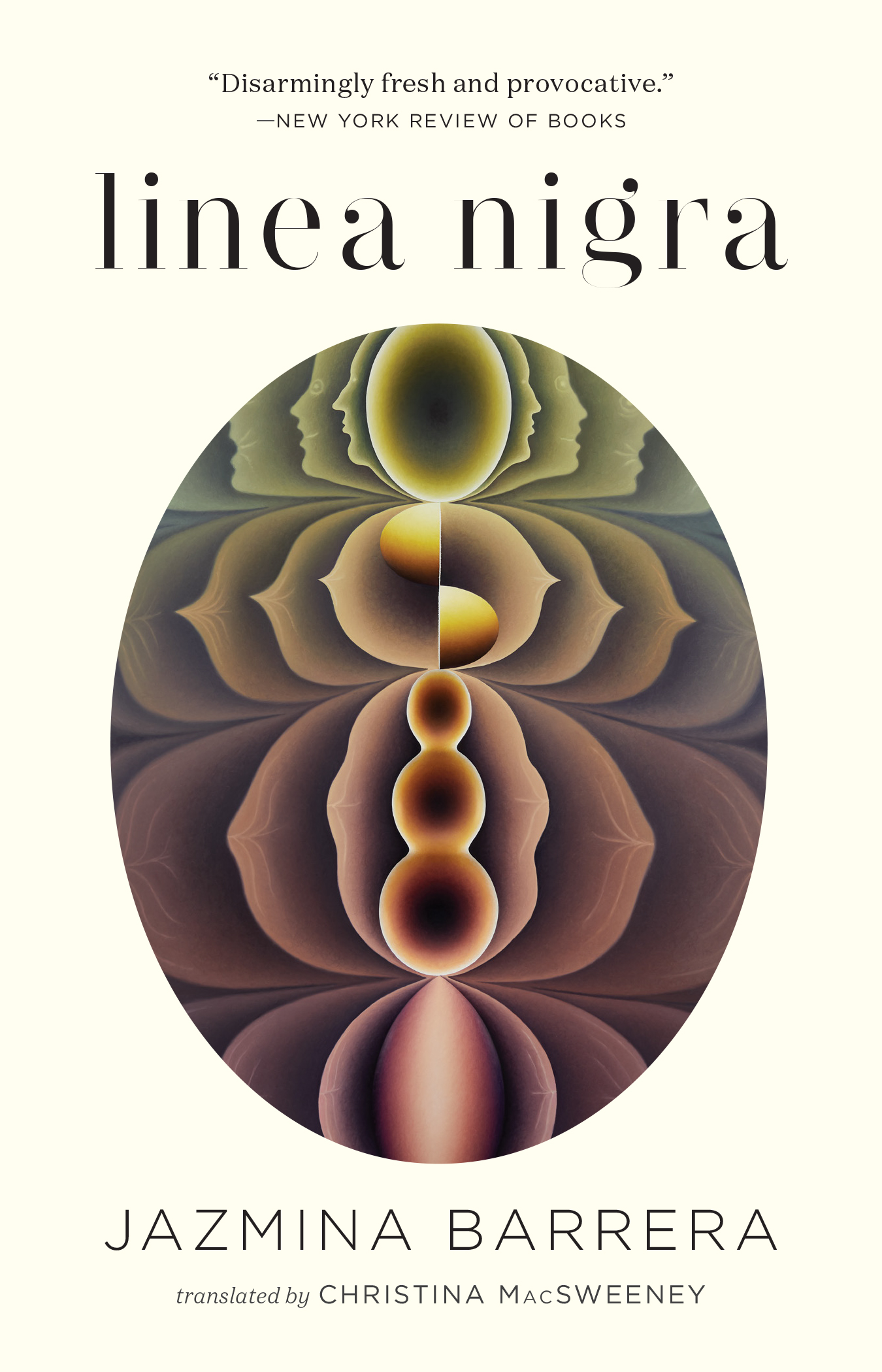
Linea Nigra
Price range: $15.95 through $21.95
Additional Info
- Format: Hardcover
- ISBN: 9781949641585
- Size: 5" x 8"
- Pages: 184
- Publication Date: May 3, 2022
- Format: Paperback
- ISBN: 9781949641301
- Size: 5" x 8"
- Pages: 184
- Publication Date: May 3, 2022
“A beautiful and lucid essay about the journey across motherhood seasons [that] sheds light on the complex and contradictory nature of gestation.” —Fernanda Melchor, The Guardian
An intimate exploration of motherhood, Linea Nigra approaches the worries and joys of childbearing from a diverse range of inspirations and traditions, from Louise Bourgeois to Ursula K. Le Guin to the indigenous Nahua model Luz Jiménez. Part memoir and part manifesto, Barrera’s singular insights, delivered in candid prose, clarify motherhood while also cherishing the mysteries of the body.
Writing through her first pregnancy, birthing, breastfeeding, and young motherhood, Barrera embraces the subject fully, making lucid connections between maternity, earthquakes, lunar eclipses, and creative labor. Inspired by the author’s own mother’s painting practice, Linea Nigra concludes with an impassioned call: childbearing is art, and art is childbearing.
Praise
Shortlisted for the Gregg Barrios Book in Translation Prize
Shortlisted for the National Book Critic’s Circle Award in Autobiography
One of the Best Nonfiction Books of 2022 (Kirkus Reviews)
One of the Most Anticipated Books of 2022 (The Millions)
One of the Best Books of 2022 So Far (Vogue)
“When interpreting pregnancy through art, no starting point is better than the musings of the Mexican writer Jazmina Barrera… To call [Linea Nigra] a memoir would be reductive—it includes so many references to fine art, literature, and history that it functions almost as an anthology or a masterfully curated museum of child-rearing.” —The Atlantic
“A strange, slim, hybrid book…disarmingly fresh and provocative… [Barrera’s] is a vision of art as feminine, never truly original or new, but a cycle: art as birth and death; bodies decomposing in the dirt, the roots ‘the tree of our flesh.’” —Christine Henneberg, The New York Review of Books
“Linea Nigra is a beautiful and lucid essay about the journey across motherhood seasons–pregnancy, childbirth, and first months of parenting. Far from mythologizing motherhood as an idealized state, Linea Nigra sheds light on the complex and contradictory nature of gestation: a state crossed by terrors, but also by hopes and love; a biological and spiritual mystery that concerns all human beings, as individuals and as a society.” —Fernanda Melchor, The Guardian
“Clear-eyed and poetic… [A] generous, openhearted project inviting readers to discover what is often hidden away, unseen.” —Los Angeles Review of Books
“By way of linea nigra—the book and the line—Barrera ultimately gestures towards the poetics of writing as a mother. The demands on the maternal body and the wonders it yields in the white-milk months inform this poetics.” —Elizabeth McNeil, Chicago Review of Books
“Essayist Jazmina Barrera takes that physical line [the linea nigra] and writes about and (metaphorically) beyond it, packing her narrative memoir full of carefully considered and exquisitely worded musings on motherhood…the multilayered, deeply felt work that her life experience and obvious talent have combined to produce is eminently worthy of acclaim.” —Vogue
“[Linea Nigra] provides a space to dialogue with the sensations, frustrations, and revelations [of motherhood] that are hard to share with anyone who hasn’t experienced them—but the book also opens a window on a fundamentally human story that has been insufficiently explored in literature.” —Words Without Borders
“Part notebook, part audiovisual anthology, Barrera’s hybrid essay Linea Nigra is not your typical book on motherhood. Instead it’s a collection that serves as representation—a comprehensive ‘compilation of images, citations, and references from women who have conceived of pregnancy, birth, and lactation through art and literature.’” —The Millions
“Once again, we are reminded to think of writing, and gestation, as acts of acculturation and accumulation. Prenatal criticism is equally witness to, and affected by, pregnancy and art—in Barrera’s words, ‘one in the center of the other.’” —Nikki Shaner-Bradford, Astra
“Christina MacSweeney’s translation from the Spanish is reminiscent of poetry, capturing a dreamy ruminative mood… Linea Nigra belongs among the few beautiful books that exist these days about motherhood and the self.” —Full Stop
“Fascinating, a self-induced literary tell-all so rarely accessed in any other form.” —The Rumpus
“An entirely idiosyncratic personal work of art… This book may have soft and curious skin, but its spine is pure steel, and as disconnected and immediate as each fragment feels, close reading reveals the meticulous skill of an artist in complete control of her work.” —Helen Zuckerman, Hopscotch Translation
“Barrera offers a moving study of pregnancy, family, art, and loss in this showstopping essay…[her] voice is meditative, bolstered by poetic turns of phrase, precise language, and fresh metaphors. ‘It’s impossible to be original when you write about being a mother,’ Barrera reflects, though her own originality is striking. This beautiful meditation is thick with profound insights.” —Publishers Weekly, starred review
“Barrera includes historical anecdotes and quotes from other women who have written about motherhood, childbirth, and pregnancy—from Mary Shelley and Natalia Ginzburg to Rivka Galchen and Maggie Nelson—and she argues that pregnancy is a fundamentally literary experience… Barrera communicates her trenchant observations in gorgeous, highly efficient prose that sharply reflects the fragmented reality of pregnancy and early parenthood. Rather than adhering to a traditional narrative structure, the author follows her trains of thought wherever they take her, and readers will be happy to tag along.” —Kirkus Reviews, starred review
“Barrera writes about pregnancy, birth, motherhood, and nursing while also drawing parallels to nature and natural occurrences, as well as art and spirituality. She captures the wonder and terror of the experience, and the creativity, rawness, and cyclic aspects of the process. It is lyrical and sharp, muscular and tender. It’s subversive and universal all at the same time.” —Jaime Herndon, Book Riot
“A memoir and also so much more… This urgent and intimate book is one of the most stunning I’ve ever read.” —Pierce Alquist, Book Riot
“Undulating musings that soothe and sustain, like a lullaby… [Linea Nigra] invokes the metaphor…that the archetype of the mother is within us even before we actually go through the process, and it is indelibly an essential part of who we are.” —Mom Egg Review
“Jazmina Barrera investigates pregnancy as both a physical reality and a liminal state…impressionistic.” —Foreword Reviews, starred review
“A refreshingly different take on traditional what-to-expect titles for mothers-to-be.” —Booklist
“Jazmina Barrera’s new book is subtitled “An Essay on Pregnancy and Earthquakes,” and to a reader first encountering this book, those two subjects might seem light-years apart. One of the more impressive accomplishments of this book is to make these two elements overlap in a surprising manner. Throw in musings on literature, art, and familial names, and you have a thoroughly compelling work.” —Words Without Borders
“Rich and lovely.” —Julie Phillips, author of The Baby on the Fire Escape
“Christina McSweeney’s sparkling translation of Barrera’s lyrical, mosaic-like passages enables the sentences to gleam in English… Barrera’s confident and beautiful book feels not only timely but also revolutionary.” —May-lee Chai, author of Tommorow in Shanghai
“This book is such a wonder and a joy. I only wish it were a few thousand pages longer, so I could have the company of its intelligence and poetry for all the phases of my life.” —Rivka Galchen, author of Everyone Knows Your Mother Is a Witch
“There is a moment in Linea Nigra where Jazmina Barrera looks at the reflection of a solar eclipse in a puddle. Barrera has a gift of obliquely looking at obvious things (in this case, pregnancy, and previously, lighthouses in On Lighthouses). Her perspective delivers deep clarity and is a joy to read. In nuanced observation, and with enormous humor, she shares how things and people can be known and understood, while allowing, as in life and death—for what can never be known, or understood.” —Leanne Shapton, author of Guestbook
“Barrera writes unflinchingly about motherhood—the minutiae, the hours nursing, the desire to make art despite exhaustion, the stitches no one talks about, the violence and beauty of birth—and creates an unforgettable tapestry that feels at once poetic and urgent. Reading Linea Nigra, I felt like I was sitting around a wise woman circle, a little more of my mother and artist self revived with each passing page. I am grateful this beautiful book exists, stares without looking away, and offers to each of us the motherhood that mainstream society doesn’t sell us. This is the real shit, and it is vital.” —Chelsea Bieker, author of Godshot
“An absolutely perfect book about mothering, writing, dismantling literary form.” —Madeleine Watts, author of The Inland Sea
“An amazing book that takes the topic of motherhood and, before the incredulous eyes of the reader, impregnates it with many other things: the body, the concept of individuality, illness, and emotional attachments.” —Emiliano Monge, author of Among the Lost
“Linea Nigra narrates the period of human gestation with such estrangement that it carries it into the genre of gothic literature. A novel that both perturbs and moves the reader.”—Guadalupe Nettel, author of After the Winter
“Linea Nigra is a rallying cry for motherhood to be taken seriously, for a maternal canon. In putting forth this rallying cry, Barrera also delivers a prime example of why one should exist.” —Lauren Cocking, Leyendo Lat Am
“At once both a meditation on and celebration of motherhood, Linea Nigra joins an elite lineage of maternal texts entwining the rituals of human, natural, and artistic creation. The result is astonishing—a beautiful book full of revelations on the depths of human connection, both with each other and the world around us.” —Josie Smith, Madison Street Books (Chicago, IL)
“Jazmina Barrera’s Linea Nigra marvels at both the magics and terrors of motherhood in inventive and captivating prose. I am stunned by the body through Barrera’s work.” —Kaitlynn Cassady, Seminary Co-op Bookstores (Chicago, IL)
“This slim volume navigates Barrera’s pregnancy, birth, and those first shattering days of early motherhood. In snippets reminiscent of the short breaks in between wakings and feedings, Barrera interweaves her reading life and lived life, creating a poignant primer that will be a kindred comfort and stalwart courage to anyone experiencing the throes of pregnancy, postpartum, and parenthood. Linea Nigra is a rich record of a life steeped in feminist art.” —Hannah DeCamp, Avid Bookshop (Athens, GA)
“Nestled within the nucleus of motherhood literature comes Linea Nigra, a sort of über-text to much that’s come before it, written in aphorism and anecdote that intersect over and over again in beautiful orbits… Barrera’s seriousness and intelligence are punctuated by expressions of delight in parenthood, what she calls the ‘simple, clear, almost ridiculous happiness I feel eighty times a day.’” —Spencer Ruchti, Third Place Books (Seattle, WA)
“In this beautiful and bold celebration of motherhood, Barrera compares the experience to an earthquake to the body. She documents all the changes, transformations and instability postpartum, told with warmth and humor. Like Maggie Nelson and Rachel Cusk before her, Barrera paints a candid portrait of motherhood that is a welcome addition to the canon.” —Michelle Leung, Toronto Public Library
“Another wonderful and insightful book from Jazmina Barrera. The beautiful details of Jazmina’s writing paired with the intimacies woven into the thoughts of everyday life allows for a deep understanding of both a individual and collective experience.” —Katie Kenney, Bank Square Books (Mystic, CT)
“Both a macro and a micro account of pregnancy thru her own testimony about her pregnancy, the accounts of her family members, and the accounts of many figures across the landscape of art and culture. Combining excellent observational writing with cultural criticism, Barrera crafts an important work of testimony.” —Bennard Fajardo, Politics & Prose (Washington D.C.)
Additional Materials

Jazmina Barrera
Jazmina Barrera was born in Mexico City in 1988. She was a fellow at the Foundation for Mexican Letters and at Mexico’s Fonca’s Program for young writers. She was a beneficiary of the residencies at Casa Estudio Cien años de Soledad. She has published work in various print and digital media, such as The Paris Review, El Malpensante, Words Without Borders, El País, The New York Times and Electric Literature. She has a Master’s Degree in Creative Writing in Spanish from New York University, which she completed with the support of a Fulbright grant. She is the author of four books in Spanish: Cuerpo extraño, Cuaderno de faros, Linea nigra and the children’s book, Los nombres de los animales and Punto de cruz. Her books have been published in nine countries and translated to English, Dutch, Portuguese Italian and French. Her book of essays Cuerpo extraño (Foreign Body) was awarded the Latin American Voices prize by Literal Publishing in 2013. Cuaderno de faros was long listed for the von Rezzori award. The English version of Cuaderno de faros, On Lighthouses, (Two Lines Press, 2020) was chosen for the Indie Next list by Indie Bound. Linea Nigra was a finalist for the National Book Critics Cricle’s Gregg Barrios Book in Translation Prize, the National Book Critics Circle Autobiography Prize, CANIEM’s Book of the year award and the Amazon Primera Novela (First Novel) Award. She is editor and co-founder of Ediciones Antílope. She lives in Mexico City. Author photo by Rodrigo Jardón.
Books
Jazmina Barrera’s books have been published in nine countries and translated to English, Dutch, Portuguese, Italian, and French. Her book Cuerpo extraño (Foreign Body) was awarded the Latin American Voices prize by Literal Publishing, and On Lighthouses was chosen for the Indie Next list by IndieBound. Linea Nigra was a finalist for the National Book Critics Circle’s Gregg Barrios Book in Translation Prize, the National Book Critics Circle Autobiography Prize, CANIEM’s Book of the Year award, and the Amazon Primera Novela (First Novel) Award. She is editor and co-founder of Ediciones Antílope. She lives in Mexico City.
Christina MacSweeney
Christina MacSweeney has an MA in Literary Translation from the University of East Anglia. Her work has been recognized in a number of important awards. Her translation of Valeria Luiselli’s The Story of My Teeth was awarded the 2016 Valle Inclán Translation Prize and also shortlisted for the Dublin Literary Award (2017). Her most recent translations include fiction and nonfiction works by Daniel Saldaña París, Elvira Navarro, Verónica Gerber Bicecci, Julián Herbert, Jazmina Barrera, and Karla Suárez. She has also contributed to anthologies of Latin American literature and published translations, articles and interviews on a variety of platforms.
Books
Christina MacSweeney’s work has been recognized in a number of important awards, and her translation of Valeria Luiselli’s The Story of My Teeth was awarded the Valle Inclán Translation Prize and also shortlisted for the Dublin Literary Award. Her most recent translations include works by Daniel Saldaña París, Elvira Navarro, Verónica Gerber Bicecci, Julián Herbert, and Karla Suárez.
Excerpt
Pregnancy is a fruit bowl. The apps tell you which fruit your fetus resembles each week as it grows. But none of the apps are written in Mexico, so they don’t take into account the wide variety of fruit we have here, the many different sizes of mangos and avocados. Alejandro says that Mexican mandarins are the same size as Chilean oranges and Chilean mandarins are the size of a Mexican lime. Plus, what I simply call a limón, he calls a limón de pica, and what he calls a limón, is for me a yellow lime.
A few days ago we went for an ultrasound scan and heard the heartbeat. The nurse said it was very strong. The fetus is the size of a blueberry, and a large part of its body is taken up by a strongly beating heart. It’s hard not to feel affection for a creature the size of a blueberry with a heart, a creature that is almost nothing except a strongly beating heart.