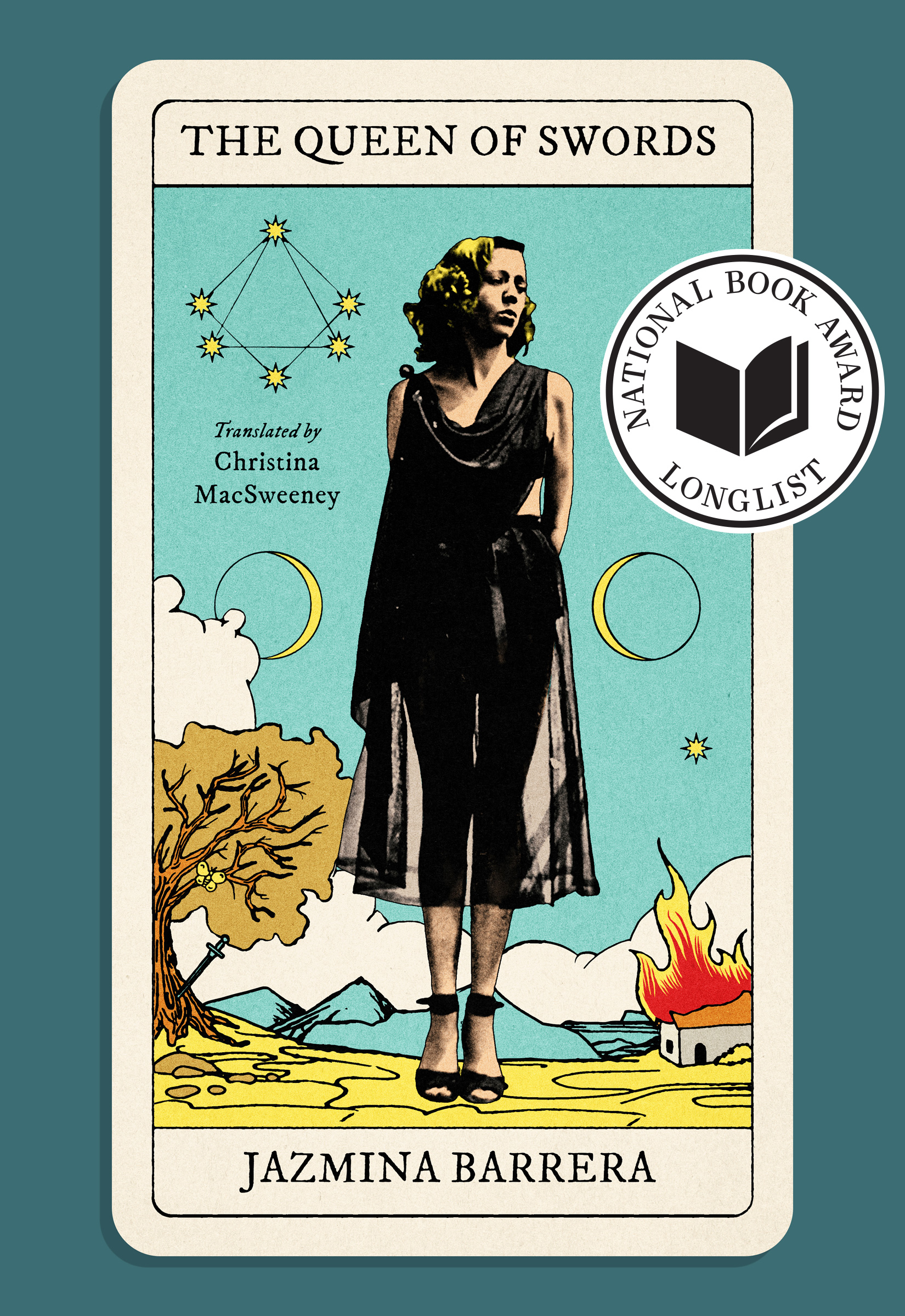
The Queen of Swords
Price range: $18.00 through $24.00
Additional Info
- Format: Paperback
- ISBN: 9781966192091
- Size: 8" x 5.5"
- Pages: 248
- Publication Date: October 27, 2026
- Format: Hardcover
- ISBN: 9781949641875
- Size: 8" x 5.5"
- Pages: 264
- Publication Date: November 11, 2025
You may also like…
-
The Week of Colors
-
Cross-Stitch
-
On Lighthouses
-
Linea Nigra
In what was at first meant to be a short essay about the influential Mexican writer Elena Garro (1916–1988), Jazmina Barrera’s deep curiosity and exploration give us a singular portrait of a complex life.
Sifting through the writer’s archives at Princeton, Barrera is repeatedly thwarted in her attempt to fully know her subject. Traditional means of research—the correspondence, photos, and books—serve only to complicate and cloud the woman and her work. Who was Elena Garro, really?
She was a writer, a founder of “magical realism,” a dancer. A devotee to the tarot and the I Ching. A socialite and activist on behalf of indigenous Mexicans. She was a mother and a lover who repeatedly shook off (and cheated on) her manipulative husband, Nobel laureate Octavio Paz. And above all, she wrote with simmering anger and glittering imagination.
The Queen of Swords is a portrait of a woman that also serves as an alternative history of Mexico City; a cry for justice; and an homage to the unknowable. It transcends mere biography, supplanting something tidy and authoritative for a sprawling experiment in understanding.
Praise
Longlisted for the National Book Award
Winner of the Cercador Prize
Indie Next Pick
“This neo-bio is a total pleasure. I’d never known Elena Garro and now I’m riveted by the entire morphing fact of her. Jazmina Barrera’s take is intimate and playful, and transgressive in the ways we generally get condemned to when considering a life, especially a literary and a female one. Here we splash dramatically, surrounded by Garro Barrera’s obsessions, toys, affairs, homes, animal friends, the works. It’s a joyous brainy blast and I’m intrigued and changed by The Queen of Swords as a reader and a writer.” —Eileen Myles
“The Queen of Swords, presented here in a lyrical translation by Christina MacSweeney, astounded the committee. Jazmina Barrera’s study on Elena Garro, a maligned pioneer of magical realism, defies convention and embraces contradiction. This is a book of reversals and research, an unwaveringly brilliant portrait of a complex and undone life, captured in art and destruction, love and pain, faith and persecution.” —Cercador Prize jury
“Barrera doesn’t hide her joys, her frustrations, her self in the writing and as a result, pushes the idea of biography forward… Form-busting, playful, and inviting.” —Literary Hub, Favorite Books of 2025
“Barrera relates Garro’s life on her own terms wherever possible, setting out a string of wild events that often reads like a thriller… The Queen of Swords is a refreshingly honest biography, one which is both example of and meditation on its form.” —The Times Literary Supplement
“A prismatic portrait of an elusive woman.” —Kirkus Reviews
“Barrera’s poetic and searching prose, her description of the experience of doing archival research, her comfort with her own uncertainty around the very facts of Elena’s life—together articulated loving an artist from a different time better than any other book I’ve read… The clarity of Barrera’s fascinations inspires me to love even more completely than I already do. Her books teach me how to love and how to live with loss. I loved it I loved it I loved it!” —Ellis Breunig, Page 2 Books (Burien, WA)
Praise for Cross-Stitch
“Needlework is often depicted as a peaceful activity: feminine, unthreatening, decorative. Yet in Jazmina Barrera’s understated and lovely debut novel, Cross-Stitch, translated from the Spanish by Christina MacSweeney, embroidery is revealed to be as quietly brutal as young womanhood, despite the shroud of innocence society often places over both.” —The New York Times
“Reflections on youth, the passage of time, and the meaning of female friendship… [Jazmina Barrera] blend[s] Sally Rooney-esque interpersonal chaos with a clean, graceful prose style.” —Vogue
“Stitches, secrets, shame: When Jazmina Barrera’s first novel translated into English, Cross-Stitch, hits shelves in November, read it. Barrera stitches a female coming-of-age story together with a feminist history and theory of embroidery, and it consumed my entire day.” —Chicago Review of Books
Praise for Linea Nigra
“When interpreting pregnancy through art, no starting point is better than the musings of the Mexican writer Jazmina Barrera… To call [Linea Nigra] a memoir would be reductive—it includes so many references to fine art, literature, and history that it functions almost as an anthology or a masterfully curated museum of child-rearing.” —The Atlantic
“Linea Nigra is a beautiful and lucid essay about the journey across motherhood seasons – pregnancy, childbirth, and first months of parenting. Far from mythologizing motherhood as an idealized state, Linea Nigra sheds light on the complex and contradictory nature of gestation: a state crossed by terrors, but also by hopes and love; a biological and spiritual mystery that concerns all human beings, as individuals and as a society.” —Fernanda Melchor, The Guardian
“Clear-eyed and poetic… [A] generous, openhearted project inviting readers to discover what is often hidden away, unseen.” —Los Angeles Review of Books
Additional Materials
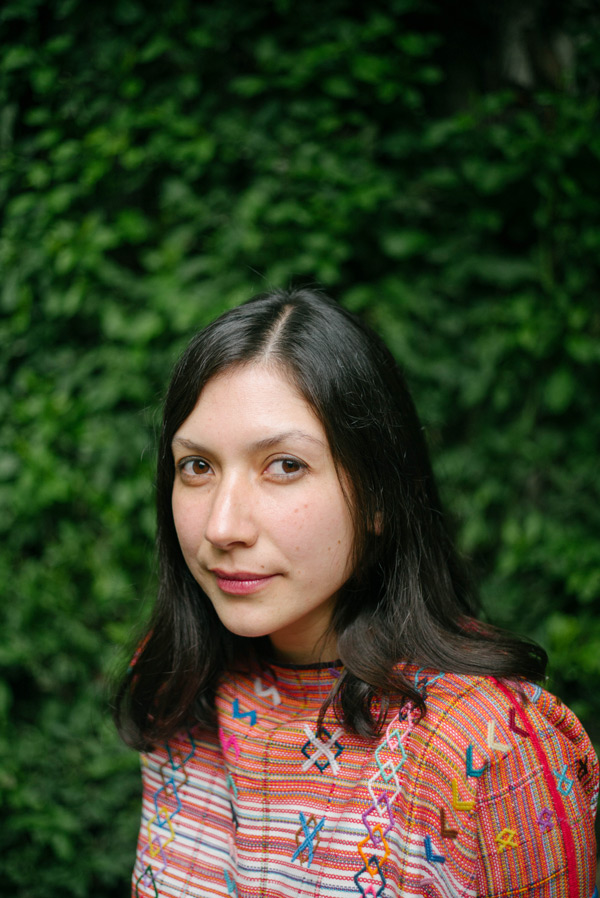
Jazmina Barrera
Jazmina Barrera was born in Mexico City in 1988. She was a fellow at the Foundation for Mexican Letters and at Mexico’s Fonca’s Program for young writers. She was a beneficiary of the residencies at Casa Estudio Cien años de Soledad. She has published work in various print and digital media, such as The Paris Review, El Malpensante, Words Without Borders, El País, The New York Times and Electric Literature. She has a Master’s Degree in Creative Writing in Spanish from New York University, which she completed with the support of a Fulbright grant. She is the author of four books in Spanish: Cuerpo extraño, Cuaderno de faros, Linea nigra and the children’s book, Los nombres de los animales and Punto de cruz. Her books have been published in nine countries and translated to English, Dutch, Portuguese Italian and French. Her book of essays Cuerpo extraño (Foreign Body) was awarded the Latin American Voices prize by Literal Publishing in 2013. Cuaderno de faros was long listed for the von Rezzori award. The English version of Cuaderno de faros, On Lighthouses, (Two Lines Press, 2020) was chosen for the Indie Next list by Indie Bound. Linea Nigra was a finalist for the National Book Critics Cricle’s Gregg Barrios Book in Translation Prize, the National Book Critics Circle Autobiography Prize, CANIEM’s Book of the year award and the Amazon Primera Novela (First Novel) Award. She is editor and co-founder of Ediciones Antílope. She lives in Mexico City. Author photo by Rodrigo Jardón.
Books
Jazmina Barrera’s books have been published in nine countries and translated to English, Dutch, Portuguese, Italian, and French. Her book Cuerpo extraño (Foreign Body) was awarded the Latin American Voices prize by Literal Publishing, and On Lighthouses was chosen for the Indie Next list by IndieBound. Linea Nigra was a finalist for the National Book Critics Circle’s Gregg Barrios Book in Translation Prize, the National Book Critics Circle Autobiography Prize, CANIEM’s Book of the Year award, and the Amazon Primera Novela (First Novel) Award. She is editor and co-founder of Ediciones Antílope. She lives in Mexico City.

Christina MacSweeney
Christina MacSweeney has an MA in Literary Translation from the University of East Anglia. Her work has been recognized in a number of important awards. Her translation of Valeria Luiselli’s The Story of My Teeth was awarded the 2016 Valle Inclán Translation Prize and also shortlisted for the Dublin Literary Award (2017). Her most recent translations include fiction and nonfiction works by Daniel Saldaña París, Elvira Navarro, Verónica Gerber Bicecci, Julián Herbert, Jazmina Barrera, and Karla Suárez. She has also contributed to anthologies of Latin American literature and published translations, articles and interviews on a variety of platforms.
Books
Christina MacSweeney’s work has been recognized in a number of important awards, and her translation of Valeria Luiselli’s The Story of My Teeth was awarded the Valle Inclán Translation Prize and also shortlisted for the Dublin Literary Award. Her most recent translations include works by Daniel Saldaña París, Elvira Navarro, Verónica Gerber Bicecci, Julián Herbert, and Karla Suárez.
Excerpt
A LIFE ON THE RUN
The beginning, at least, is clear. In 1916, in the small Asturian town of Cangas de Onís, a Mexican woman named Esperanza Navarro learned that her Spanish husband, José Antonio Garro, was having an affair with her cousin. Esperanza was eight months pregnant and understandably furious. So, she sold her jewels and set out with her two-year-old daughter, Devaki, for the port of Vigo. There, she boarded a ship bound for Veracruz, from where she took a train, with the intention of eventually reaching Mexico City. Losing the race against her biological clock, she went into labor in Puebla, where her sister Consuelo lived. On December 11, 1916, Elena Delfina Garro Navarro was born. And thus, while still in the womb, began a life on the run.