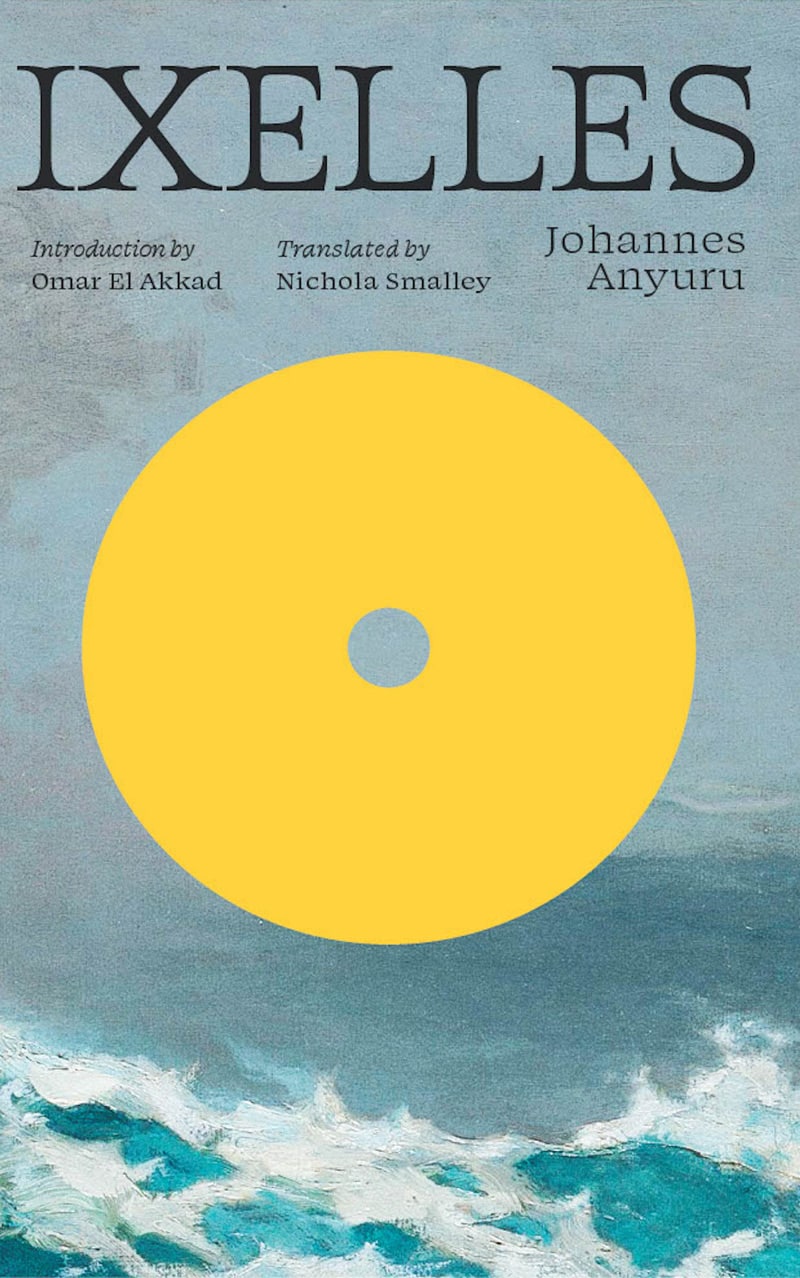
Ixelles
$20.00
2 in stock (can be backordered)
Additional Info
- ISBN: 9781949641691
- Size: 5" x 8"
- Pages: 468
- Publication Date: October 8, 2024
A thrilling literary novel about the inescapability of the past and the power of fiction for fans of Jeff Vandermeer and Colson Whitehead, Anyuru’s latest examines contemporary city life with a cool eye and brilliant imagination, casting its characters in a heartrending drama of possibility.
Ruth lives comfortably with her son, Em, in a house by the sea. She has a well-paying job at the Agency, a firm that creates elaborate fictions to shape public opinion. Their lives weren’t always like this. Ruth had to get Em out of Antwerp’s hopeless postal code Twenty-Seventy, the neglected neighborhood where Em’s father, Mio, was murdered when she was still pregnant. A new assignment forces her to return to the place she once called home, and she’ll need to convince old friends and family—the only people in her life who connect her to her past—to remain silent as the government demolishes it all. Amid this upheaval, Ruth discovers a golden CD with a voice on it claiming to be Mio. He is in a place called the Nothingness Section, which may be an island or just another piece of fiction. In Anyuru’s story of stories, are there any tales where Mio can end up with Ruth, raising his son by the sea?
With an introduction by Omar El Akkad.
Praise
“Anyuru has a talent for showing the seams in society’s sewing. Often, Ixelles reads like faint transmissions from uneasy, adjacent universes. There is something of Borges that runs through the novel–a child’s compendium of monsters from a role-playing game; past lives that refuse to die; the gravity of a library, that desperate wanting to be consumed by a story, by many stories at once; belonging as a matter of narrative ownership. It occurs to me that, just as so many of Borges’s characters might be said to share his fear of dying in a language they can’t understand, Anyuru’s characters often navigate the world as though gripped by a fear of dying in a culture that doesn’t understand them.” —from the introduction by Omar El Akkad
“[An] excellent translation… [Ixelles] is a rich, strange novel that cuts at something deeply human in us—the urge to tell stories, to mythologize, to rewrite—and masterfully explores the pain and hurt of being human.” —Chicago Review of Books
“Living on the blurred boundary between SFF and naturalistic fiction… [Ixelles] hold[s] its secrets to its chest right to the bitter end. It is beautifully, poetically told, deeply human, entirely cynical and yet a little hopeful. Anyuru shows us the world as it is—mundane, grim, contradictory and full of people’s wishes— and offers something small, something bright, a single thread of gold running through the grey of it all.” —The Ancillary Review of Books
“In the provocative latest from Anyuru, a shadowy PR agency takes a novel approach to promoting its clients’ interests…a dreamscape of disembodied voices.” —Publishers Weekly
“Any novel that gets comped to both Jeff VanderMeer and Colson Whitehead is going to be an auto-pick-up for me. This one follows a woman who works ‘creating elaborate fictions to shape public opinion’ as she returns to her old home—where she finds a CD with the voice of someone claiming to be her dead husband. It’s giving slipstream strangeness and I’m ready for it.” —Literary Hub (Most Anticipated Books of 2024)
“A grim but tantalizing portrayal of Sweden…propulsive and tender.” —Ourculture
“A multilayered novel blending mystery, SF, and politics in an uneasily multicultural Europe…part Borges, part Stieg Larsson, and part the P.D. James of The Children of Men… Memorably inventive: the work of a writer, well established in Sweden, whom American readers will want to know.” —Kirkus Reviews
“Tender and tense…a reflective novel about the dangerous allure and empowering vindication of using fiction to cope with reality.” —Foreword Reviews, starred review
Praise for They Will Drown in Their Mothers’ Tears
“[They Will Drown in Their Mothers’ Tears] has a powerful emotional core… Anyuru’s ability to imagine a thread connecting present-day exclusion to future atrocities makes this more than a genre entertainment. He has written a “state of the nation” novel for a country that seems to be losing faith in the civic values for which it is internationally admired.” —Hari Kunzru, The New York Times
“Anyuru underscores the reality that even parallel worlds involve global connections… Each of his characters feels real, whether experiencing friendship and delight or torture and death.” —NPR
“It’s a rare author who has such sensitivity with explosive materials… Saskia Vogel’s translation achieves a difficult balance, nimble yet compassionate. She captures Annika’s mash-up of Western slang and Koranic Arabic, its humor often a relief, and also the more complex contemplations of the writer, poetic and touching… I came away thinking of the book as an attempt to forge a more humane means of expression, one that could surmount all our fears and failures.” —The Washington Post
“An ingeniously plotted work… Anyuru’s dystopia persuades because it is inextricable from the anxieties of his Muslim characters in contemporary Sweden, from disaffected youths who sell hash and flirt with radicalism to imams preaching forbearance in cramped basement mosques. The grammar of their faith, from its rituals of prayer to its reassurances of eternity, offers a means of orientation beyond precarious circumstances—as well as a counterpoint to the nativist equation of birthplace and belonging.” —Harper’s Magazine
“[Anyuru]…turns a novel about terrorism, time travel and alternative realities into something even stranger than those things: a philosophical meditation on hope.”
—San Francisco Chronicle
Additional Materials
- “The Order of Circles Within Circles: Review of Johannes Anyuru’s Ixelles,” in Ancillary Review of Books
- “Alhambra,” nonfiction by Johannes Anyuru and translated by Kira Josefsson, in Words Without Borders
- Excerpt from Ixelles, in Literary Hub
- Introduction to Ixelles by Omar El Akkad, Two Lines Press exclusive
- Ixelles Reader’s Guide
- Request an Exam or Desk Copy

Johannes Anyuru
Johannes Anyuru is a poet, novelist, and playwright. He debuted in 2003 with the critically acclaimed collection of poems Only The Gods Are New. They Will Drown in Their Mothers’ Tears was awarded the August Prize and film rights have been acquired by Momento Film. Anyuru’s work has been likened to a mix between Nobel Laureate Thomas Tranströmer and a hip-hop MC.
Books
Johannes Anyuru is a poet, novelist, and playwright. He debuted in 2003 with the critically acclaimed collection of poems Only The Gods Are New. They Will Drown in Their Mothers’ Tears was awarded the August Prize and film rights have been acquired by Momento Film. Anyuru’s work has been likened to a mix between Nobel Laureate Thomas Tranströmer and a hip-hop MC.
Nichola Smalley is a translator and lover of Swedish and Norwegian literature. In 2014 she finished her PhD exploring the use of contemporary urban vernaculars in Swedish and UK rap and literature at UCL. Her translations range from Jogo Bonito by Henrik Brandão Jönsson (Yellow Jersey Press), a Swedish book about Brazilian football, to the latest novel by Norwegian superstar Jostein Gaarder, An Unreliable Man (Weidenfeld & Nicolson).
OMAR EL AKKAD is an author and journalist. He was born in Egypt, grew up in Qatar, moved to Canada as a teenager and now lives in the United States. He is a two-time winner of both the Pacific Northwest Booksellers’ Award and the Oregon Book Award. His books have been translated into 13 languages. His debut novel, American War, was named by the BBC as one of 100 novels that shaped our world.
Excerpt
A food delivery rider in a muddy, neon-green padded jacket said that the Nothingness Section was a city the French had built somewhere along the North African coast, with hotels and boulevards and concert halls. When they lost it to the Arabs in a war, they’d erased every trace of it from the maps.
He said the streets were lined with beheaded statues, and that the people lived in tents on the squares and rooftops, because the buildings themselves were full of bookcases and boxes – the whole town is one enormous archive: a library of the memories and hopes of the poor.