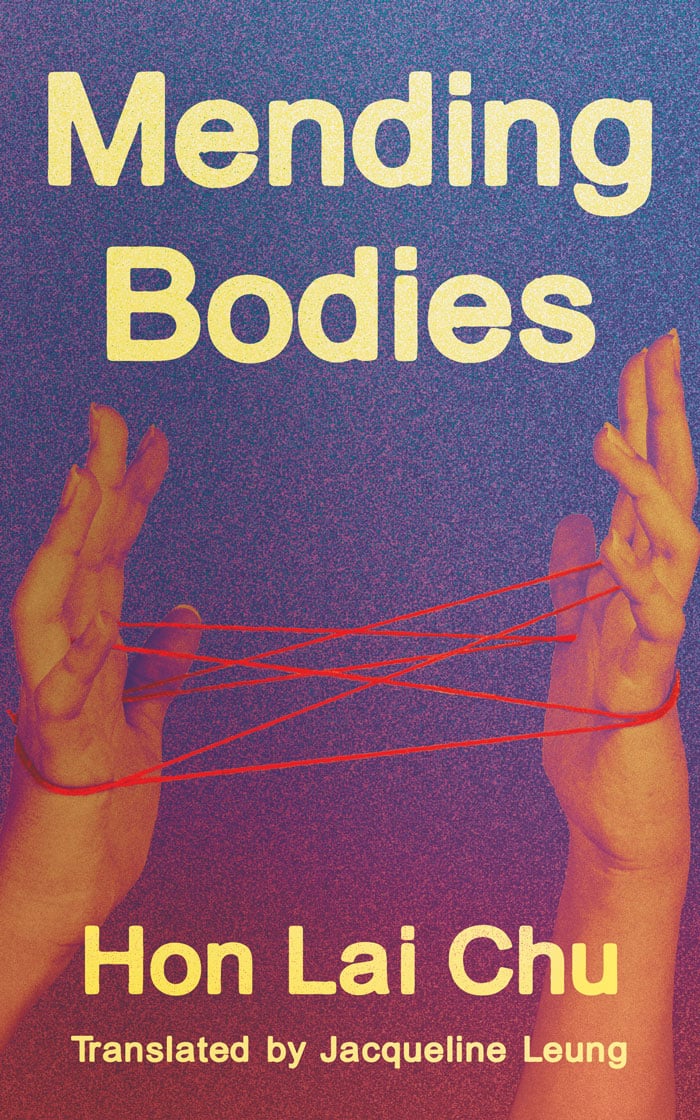
Mending Bodies
$18.00
Additional Info
- ISBN: 9781949641769
- Size: 5" x 8"
- Pages: 240
- Publication Date: April 29, 2025
For readers of Ling Ma and Sayaka Murata, Hon Lai Chu’s dystopian exploration of body autonomy, relationships, and late capitalism defies and then reassembles dark realities.
Praise
“An unsettling fable about an extreme form of cohabitation… Hon’s turns of phrase are consistently arresting (“The self proliferates as incessantly as mold”). This intelligent speculative work is eerily transfixing.” —Publishers Weekly
“In this original body horror, couples are encouraged to surgically attach themselves for the good of society. As the narrator writes her dissertation on conjoined twins, she debates whether to have the surgery herself in this examination of autonomy, freedom and assimilation.” —Ms. Magazine, Reads for the Rest of Us
“Not at all what I was expecting. Raises some interesting questions about personal freedom, bodily autonomy, and identity, in the format–not of a dystopia–but of an alternate reality that hits disturbingly close to home. An early favorite for 2025!” —Tony Paese, Books & Company (Oconomowoc, WI)
“Strange dreams and complex metaphors combine to create a dazzling, hallucinatory portrait of societal alienation.” —Charlie Marks, Fountain Books (Richmond, VA)
Praise for The Kite Family
“Evocatively written and expertly translated, these Hong Kong stories will draw you into Hon Lai Chu’s surreal and yet recognizable world.” —Howard Goldblatt, translator of Nobel laureate Mo Yan
Additional Materials

Hon Lai Chu
Hon Lai Chu is one of Hong Kong’s most prominent writers and the author of several novels, including Mending Bodies, Degravitation Zone, and A Dictionary of Two Cities, co-authored with Dorothy Tse, which won the Hong Kong Book Prize. Her most recent works are Half-Eclipse and Darkness under the Sun, two diaristic essay collections about Hong Kong. She has also received accolades from Taiwan’s Unitas Literary Association, the Liang Shiu-chiu Literature Award, the Dream of the Red Chamber Award, and the Hong Kong Biennial Awards for Chinese Literature, among many others.
Books
Hon Lai Chu is one of Hong Kong’s most prominent writers and the author of several novels, including Mending Bodies, Degravitation Zone, and A Dictionary of Two Cities, co-authored with Dorothy Tse, which won the Hong Kong Book Prize. Her most recent works are Half-Eclipse and Darkness under the Sun, two diaristic essay collections about Hong Kong. She has also received accolades from Taiwan’s Unitas Literary Association, the Liang Shiu-chiu Literature Award, the Dream of the Red Chamber Award, and the Hong Kong Biennial Awards for Chinese Literature, among many others.

Jacqueline Leung
Jacqueline Leung is a writer and translator from Hong Kong. Her work has appeared in Wasafiri, Transtext(e)s Transcultures, Gulf Coast, Asymptote, Nashville Review, SAND Journal, the Asian Review of Books, Books From Taiwan, and elsewhere. She is a translator editor at The Offing. Her excerpt of Mending Bodies is a winner of PEN Presents by the English PEN. This is her first full-length translation.
Books
Jacqueline Leung is a writer and translator from Hong Kong. Her work has appeared in Wasafiri, Transtext(e)s Transcultures, Gulf Coast, Asymptote, Nashville Review, SAND Journal, the Asian Review of Books, Books From Taiwan, and elsewhere. She is a translator editor at The Offing. Her excerpt of Mending Bodies is a winner of PEN Presents by the English PEN. This is her first full-length translation.
Excerpt
A newspaper article predicted that we would no longer see any mountain peaks, seas, or adult bodies that were whole in twenty years. We had grown accustomed to these horrifying speculations, the same way we read about faraway countries with long and foreign-sounding names wrecked by war, earthquake, storms, and massacres. There would be a moment of grief plunging us into a chasm of silence, but the next moment, with the turn of a page, we would be inundated by job and real estate listings and restaurant advertisements. People weren’t indifferent, it was just that, for those of us who lived here, the future seemed far removed from reality.