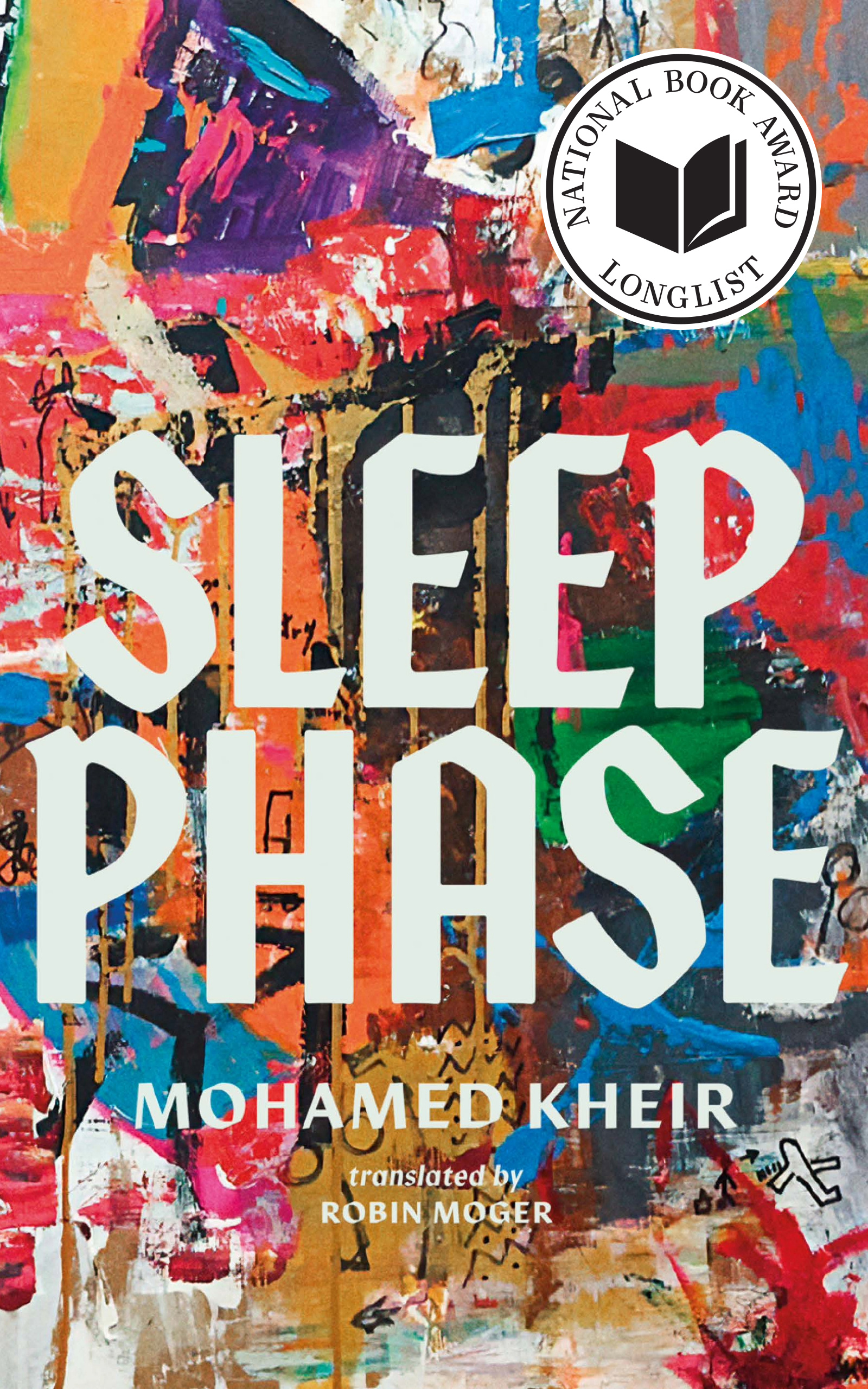
Sleep Phase
$18.00
Additional Info
- ISBN: 9781949641783
- Size: 5" x 8"
- Pages: 240
- Publication Date: May 13, 2025
After seven years in prison, Warif is released to a changed Cairo.
Freedom so far has been endless, inscrutable meetings with official-looking strangers, trying to get his job as a translator back. This new Cairo, busy with expats and bureaucrats, is proving disorienting: What is he supposed to make of these self-assured newcomers who are so certain of his obsolescence, his subjugation, his solitude? They seem happy to provide him with a salary, if he’s willing to give up the work that gave his life meaning. As his encounters more and more resemble interrogations and the futility of trying to escape the system set against him threatens to suffocate him, Warif escapes into the vivid colors of the city, looking deeper and deeper into the food, the people, the buildings, and the flowers, until what’s real blurs into fantasy.
Praise
“Dreams and reality blur in this caustic and Kafkaesque tale from Egyptian author Kheir (Slipping)… This eerie and taut tale will leave readers with plenty to chew on.” —Publishers Weekly
“Sleep Phase unfurls into a Kafkaesque account of blurry English-speaking bureaucrats with unplaceable accents in vast, echoing public buildings with unlabeled doors… As past and present surreally converge, Kheir uses his characters’ ever-shifting perception of their surroundings to probe the truths around globalization and its consequences, patriotism and its faults, free speech and its oppression… Simultaneously paralleled on various levels of human intimacy, it is Warif’s disorientation that soon fosters his ability to navigate the questions of who he was before his arrest—and who he still can be.” —Asymptote
Praise for Mohamed Kheir and Slipping
“A partly real, partly fantastical depiction of post-revolutionary Cairo and Alexandria as seen through the stories of a struggling journalist, a former exile and a difficult love affair. Featuring giant flowers bigger than people and episodes of walking on water, the fantastical in this novel feels as true to the Cairo of today as the parts that are lifted from life.” —Yasmine El Rashidi, The New York Times
“Connecting the fragmentary and seemingly contradictory details of the novel’s architecture makes for a thrilling read. It would take many passes to join every last piece of the puzzle, but as any puzzler knows, part of the fun comes from those small epiphanies that get us a tiny step closer to illumination.” —Chicago Review of Books
“Push[es] both its characters and its readers to extend their minds beyond the limits of what’s possible.” —Seattle Times
“As the title suggests, this novel’s form is elusive, its language at times meltingly beautiful, or sophomoric in a slapstick way. I was especially struck by its ending, doubly surprising in such a surreal, fragmented novel whose plot had at times felt distant from it.” —Hannah Gold, The Millions
Additional Materials
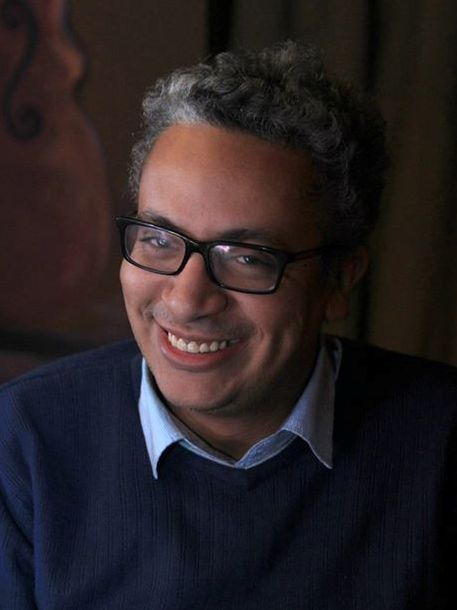
Mohamed Kheir
Mohamed Kheir is a novelist, poet, short story writer, journalist, and lyricist. His short story collections Remsh Al Ein (2016) and Afarit Al Radio (2011) both received The Sawiris Cultural Award, and Leil Khargi (2001) was awarded the Egyptian Ministry of Culture Award for poetry. Slipping (Eflat Al Asabea, Kotob Khan Publishing House, 2018; Two Lines Press, 2021) is his second novel and his first to be translated into English. He lives in Egypt. Author photo by maha al turk.
Books
Mohamed Kheir is a novelist, poet, short story writer, journalist, and lyricist. Slipping (Eflat Al Asabea, Kotob Khan Publishing House, 2018; Two Lines Press, 2021) is his second novel and his first to be translated into English. He lives in Egypt.
Robin Moger
Robin Moger is a translator of Arabic to English currently based in Cape Town, South Africa. His translations of prose and poetry have appeared in Blackbox Manifold, The White Review, Tentacular, Asymptote, Words Without Borders, Seedings, The Johannesburg Review of Books, The Washington Square Review and others. He has translated several novels and prose works into English including Iman Mersal’s How To Mend (Kayfa ta), Nael Eltoukhy’s The Women of Karantina (AUC Press) and Youssef Rakha’s The Crocodiles (7 Stories Press). His translation of Haytham El Wardany’s The Book Of Sleep is forthcoming from Seagull Press in November 2020.
Books
Robin Moger is a translator of Arabic to English currently based in Cape Town, South Africa. He has translated several novels and prose works into English including Iman Mersal’s How To Mend (Kayfa ta), Nael Eltoukhy’s The Women of Karantina (AUC Press) and Youssef Rakha’s The Crocodiles (7 Stories Press).
Excerpt
About two decades before the bridge had been decommissioned and dismantled. When they started building it again it had been like a video playing in reverse: tons and tons of broken up metalwork reassembled, steel ornaments reaffixed, even the great lamps once installed on the the bridge’s stone pillars had been dug up from where they lay in the dirt and rust, the rats and snakes, and mounted over the river as before, this time on a great semicircle that arced out from the Corniche where the neighbourhood Aboul Ela once stood, to rejoin it further down. The bridge could also open to let the river boats through, and when their sails were tall enough and there were people gathered on the walkways either side, it looked like giant shark fins moving through a crowd, though the cries that greeted them were of glee not terror, and musicians on either side of the breach would playa tune each time one went by. Sally was humming along, sitting on the edge of the bridge with her legs swinging in the air and her back resting against one of those resurrected antique lamp posts. It looked so much like her feet must be wetting themselves in that water, that he couldn’t resist leaning forward every now again, as though he needed to remind himself that it couldn’t be her setting the Nile’s tiny eddies spinning.