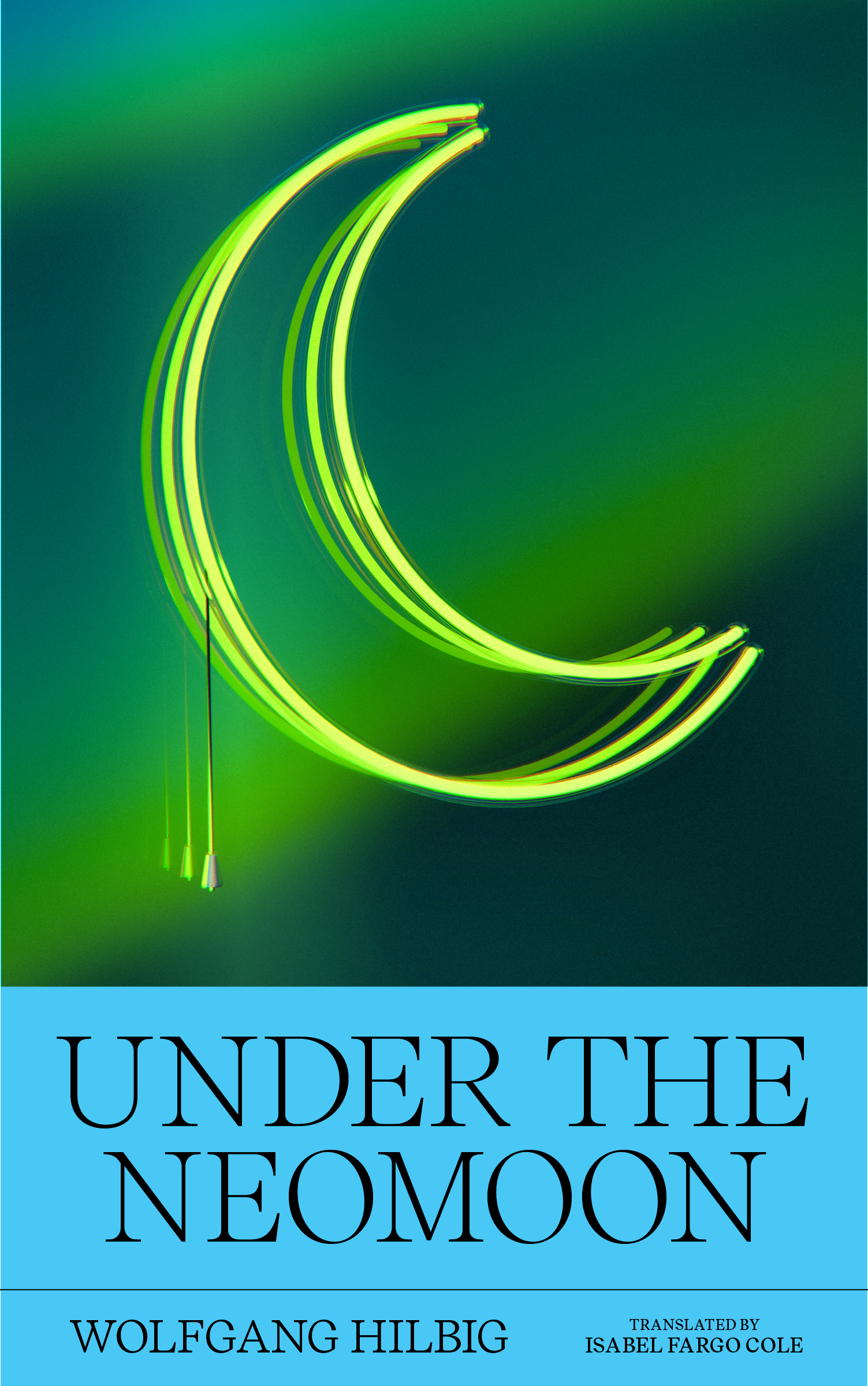
Under the Neomoon
$16.95
Additional Info
- ISBN: 9781949641615
- Size: 5" x 8"
- Pages: 172
- Publication Date: June 11, 2024
An electric collection that evokes the works of Andrei Tarkovsky and Ingeborg Bachmann, Under the Neomoon is a neon-tinged mediation on humanity’s violent folly and the importance of storytelling from below.
An abandoned construction site. Glowering pits and furnaces. A lone man in a bungalow. Widely considered to be one of the great German writers of the twentieth century, Wolfgang Hilbig’s dark visions have long held readers aloft with their musical language and uncompromising assessment of the modern world. In Under the Neomoon, his debut short story collection originally published in East Germany in 1982, Hilbig’s persistent fixations—factory pits, rampant nature, and split identities—are at their most visceral and brilliant. Rendered into English by Hilbig’s longtime translator Isabel Fargo Cole, these short tales apply fluorescent language (“garlands of cast-iron flowers,” “tall dark-green water grasses”) to lives and spaces of foreclosed dreams. An electric collection that evokes the works of Andrei Tarkovsky and Ingeborg Bachmann, Under the Neomoon is a neon-bright reminder of the importance of storytelling from down below, where the workers toil.
Praise
“Hilbig’s stories are part working-class memoir and part gothic fiction, lyrical and unsettling, verging at times on Lovecraftian pulp horror—a genre, alongside American Westerns, that he eagerly consumed in his youth. The stories in Under the Neomoon, which range from two-page flash pieces to a nearly novella-length work, showcase both ends of this genre spectrum.” —Los Angeles Review of Books
“Work and nature wrestle everywhere in these stories…the simplest turns of phrase delight.” —Kirkus Reviews
“Radiant… Hilbig’s bold lyricism stands out, as does his textured portrait of an artist’s disillusionment with East German communism. It’s a valuable time capsule.”
—Publishers Weekly
“Translator Isabel Fargo Cole has turned an already beautiful work into poetry, stretching sentences into a slow long pull of compounded run-ons, seamlessly folding into one another.” —Manda Barker, The Raven Book Store (Lawrence, KS)
Praise for Wolfgang Hilbig
“Comic and terrifying and profound.” —Rachel Kushner, The Guardian
“…a grouch in the tradition of Thomas Bernhard, and it is a joy…” —The Times Literary Supplement
“In Hilbig’s visions, this dissolution of boundaries—between nations and classes, present and past—feels almost ecstatic.” —The Baffler
“Wolfgang Hilbig is an artist of immense stature.” —László Krasznahorkai, author of Baron Wenckheim’s Homecoming
“…a funny yet anguished mind caught between competing visions of the world.” —The New York Times
“…deserves to be as well known in the Anglophone world as Thomas Bernhard or Günter Grass.” —Hari Kunzru, author of Red Pill
“Hilbig’s was among the most significant prose and poetry written not just in the GDR but in all of postwar Germany—East or West.” —Joshua Cohen, Pulitzer Prize–winning author of The Netanyahus
“Evokes the luminous prose of W. G. Sebald.” —The New York Times
“[Hilbig writes as] Edgar Allan Poe could have written if he had been born in Communist East Germany.” —Los Angeles Review of Books
“[Hilbig] could very well be the writer for our time.” —Boston Review
“Whenever I read Hilbig’s books…I am profoundly shaken. This language practically slices me open.” —Clemens Meyer, author of While We Were Dreaming
“Out of the ugliness of history and the wasted landscape of his home, he has created stories of disconsolate beauty.” —The Wall Street Journal
Additional Materials
- “Peering Through the Darkness: Under the Neomoon and Territories of the Soul/On Intonation in review,” in the Los Angeles Review of Books
- “The Stoker,” a biographical essay, in Poetry Foundation
- “The Workers: An Essai,” excerpt from Under the Neomoon, in The Baffler
- Under the Neomoon Reader’s Guide
- Request an Exam or Desk Copy
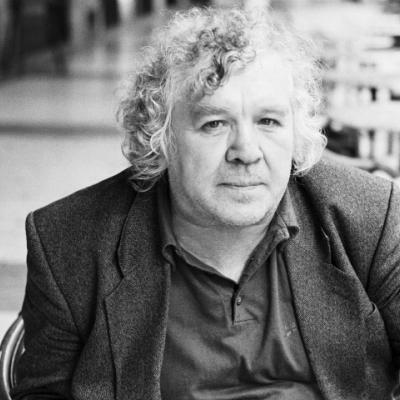
Wolfgang Hilbig
Wolfgang Hilbig was born in 1941 in the coal-mining region of Meuselwitz, Saxony; his father fell in the battle of Stalingrad. Hilbig worked as a stoker in East Germany’s industrial wasteland, and his densely poetic texts literally emerged from the boiler-room. But he was too independent and his work too dark to fit in with the new breed of working-class poets fostered by the German Democratic Republic. An autodidact, he read voraciously, and was influenced by German Romantics such as E. T. A. Hoffmann and Ludwig Tieck, as well as Edgar Allan Poe, Samuel Beckett, and Bob Dylan. In 1985, Hilbig moved to West Germany, but remained a profoundly East German writer, addressing the conflicts of his Eastern-Western existence with an intensity that made him one of Germany’s most important postwar writers. In 2002 Hilbig was awarded the Büchner Prize, Germany’s most prestigious literary award, for his life’s work. He died in 2007 after a long struggle with cancer, leaving a substantial oeuvre of poetry, short prose, novellas, and novels. (Photo credit: 3:AM Magazine)
Books
Wolfgang Hilbig (1941–2007) was one of the major German writers to emerge in the postwar era. Though raised in East Germany, he proved so troublesome to the authorities that in 1985 he was granted permission to emigrate to the West. The author of more than twenty books, he received virtually all of Germany’s major literary prizes, capped by the 2002 Georg Büchner Prize, Germany’s highest literary honor.

Isabel Fargo Cole
ISABEL FARGO COLE is a U.S.-born, Berlin-based writer and translator. Her translations include five books of Wolfgang Hilbig’s, including Old Rendering Plant, for which she received the Helen and Kurt Wolff Translator’s Prize. She has also been the recipient of a prestigious PEN/Heim Translation Grant, and her novel Die grüne Grenze was a finalist for the 2018 Preis der Leipziger Buchmesse. (Photo credit: Emma Braslavsky)
Books
Isabel Fargo Cole is a U.S.-born, Berlin-based writer and translator. Her translations include five books of Wolfgang Hilbig’s, including Old Rendering Plant, for which she received the Helen and Kurt Wolff Translator’s Prize. She has also been the recipient of a prestigious PEN/Heim Translation Grant, and her novel Die grüne Grenze was a finalist for the 2018 Preis der Leipziger Buchmesse.
Excerpt
The grass was pleasantly warm and damp, the sun shone in my eyes, and blinking, already nearly insensate, I felt sleep draw near. – Let the devil go into town, I thought, let the devil go be mollified by the security of town. – That thought mollified me, my need for sleep was so strong, my body feather-light, I knew I was really already sleeping, yet I could rise at any moment and go back to the mill, my feet just grazing the tips of the grass, borne by sun-warmth and sleep, and before falling sound asleep I argued: what am I supposed to do in town, hunkered in my lodgings, paying rent, paying taxes, gobbling food, guzzling drink, living like other people, forgetting, spending all my time forgetting, sitting in my chair forgetting, staring out the window at the forgotten street, until I can hardly get up from my forgotten chair to strangle myself with my neckties. Am I supposed to make people’s acquaintance there, people whose friendliness sickens me. Am I supposed to work there, work, work, work. How dreary, how pathetic to work. How degraded to get haircuts, to shave, how miserable to wash and dress according to the fashion. How sad to be healthy and sound, placid, forgetful, how tiresome, how tiresome to know what country I live in, and know it without wrath, and have to hold this always and without wrath in my dreary consciousness.