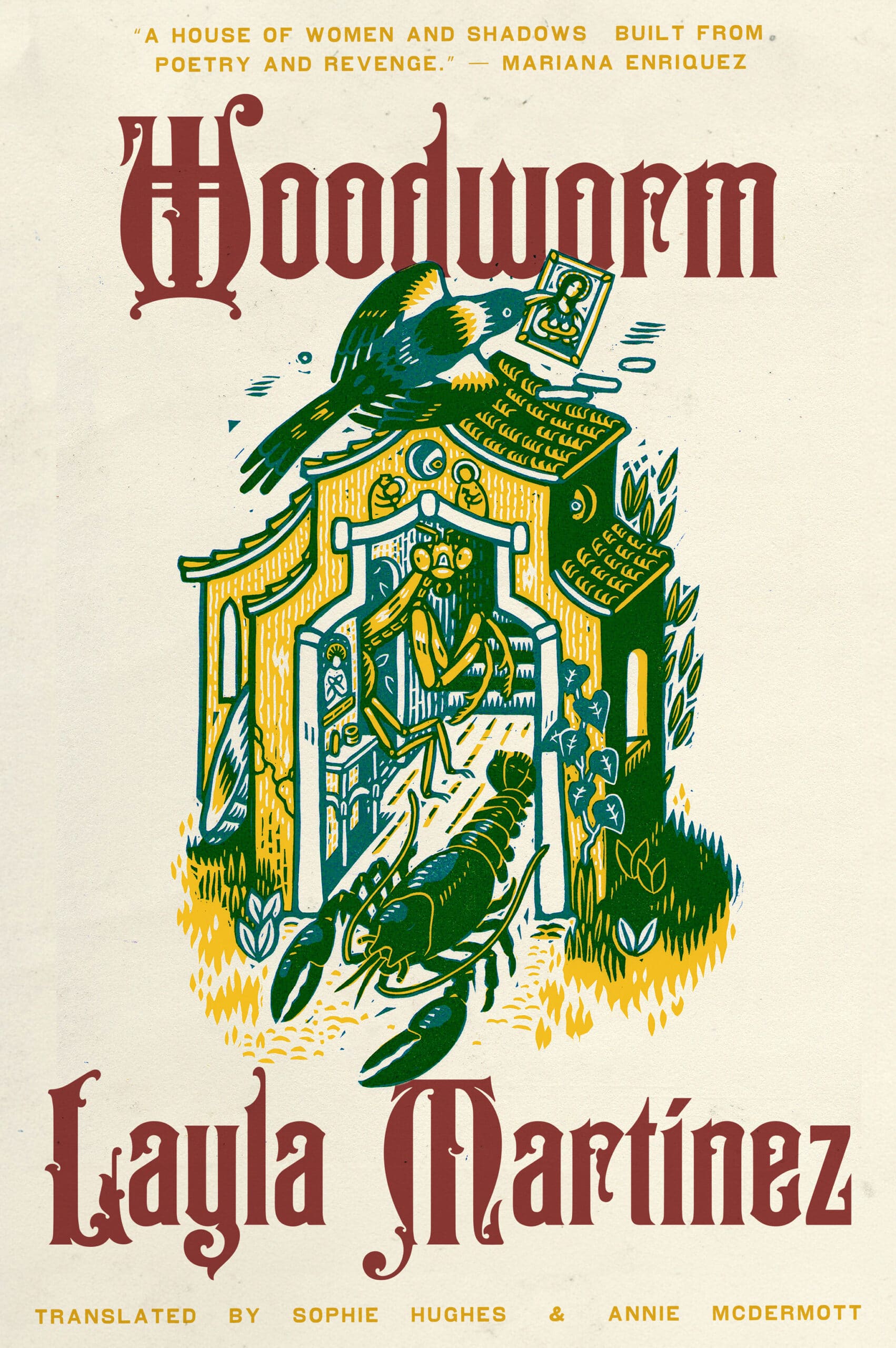
Woodworm
$21.95
Additional Info
- ISBN: 9781949641592
- Size: 5" x 8"
- Pages: 144
- Publication Date: May 14, 2024
For fans of Samanta Schweblin and Fernanda Melchor, Layla Martínez’s debut novel with its grisly, mystical vision of justice for an unjust world, announces a terrifying new voice in international horror.
The house breathes. The house contains bodies and secrets. The house is visited by ghosts, by angels that line the roof like insects, and by saints that burn the bedsheets with their haloes. It was built by a smalltime hustler as a means of controlling his wife, and even after so many years, their daughter and her granddaughter can’t leave. They may be witches or they may just be angry, but when the mysterious disappearance of a young boy draws unwanted attention, the two isolated women, already subjects of public scorn, combine forces with the spirits that haunt them in pursuit of something that resembles justice.
In this lush translation by Sophie Hughes and Annie McDermott, Layla Martínez’s eerie debut novel is class-conscious horror that drags generations of monsters into the sun. Described by Mariana Enriquez as “a house of women and shadows, built from poetry and revenge,” this vision of a broken family in our unjust world places power in the hands of the eccentric, the radical, and the desperate.
Praise
Longlisted for the National Book Award for Translated Literature
A Must-Read Book of Spring 2024 (Polygon)
A Most Anticipated Book of Spring 2024 (The Millions)
“Vengeance and ghostly visitations undergird this début novel about a young woman and her grandmother who live in a house where they are plagued by what they call ‘the woodworm’: a ‘bastard itch that won’t leave you in peace or let you leave others in peace either.’ The women’s story is anchored in a long-simmering feud with their wealthier neighbors, which reaches back generations; when a child goes missing, the town’s collective suspicions fall on the granddaughter, and the conflict boils over into the present. Shadowed by the Spanish Civil War and the remarkable cruelty of men, the violent tale unspools into a potent consideration of inherited trauma and the elusiveness of justice.” —New Yorker
“Wonderfully bizarre and ceaselessly creepy…an exceptionally gloomy tale of anger and isolation, filled with strangeness, and delivered with sharp and fast prose. Through it all, Martínez explores larger topics of class resentment and the lingering effects of evil. Intergenerational trauma and monsters share the spotlight in this terrific debut.” —Gabino Iglesias, The New York Times
“Layla Martínez’s debut novel is a claustrophobic slice of domestic horror, steeped in Catholicism and the supernatural, concerning a grandmother and granddaughter who share a haunted house in the barren Spanish interior… With impressive economy and hurtling intensity, Woodworm emits a howl of fury against entrenched inequality and enforced servitude, and the constraints they place on working-class women. In the gothic tradition the insatiable house becomes a metaphor: for societal structures and the inescapable stranglehold of history, echoing the grandmother’s ominous mantra, ‘nobody ever leaves.’” —The The Times Literary Supplement
“Chilling and beguiling, Woodworm is a work of ghostly wrath, about women who remember and men who forget, and how wealth lets the real monsters thrive in plain sight.” —Polygon
“A house of women and shadows, built from poetry and revenge. Layla Martínez’s tense, chilling novel tells a story of specters, class war, violence and loneliness, as naturally as if the witches had dictated this lucid, terrible nightmare to Martínez themselves.” —Mariana Enriquez, author of Our Share of Night
“What gives Woodworm its spark is its balanced complexity. So much is packed in and all of it unfurls like a silk ribbon. It’s a mystery. It’s a political commentary. It’s a genre-pleasing paranormal tale. Never is it too busy or distracted from its purpose. Every word is charged with menacing magic and readers will willingly fall victim to its curse.” —Fangoria
“Martinez’s debut novel takes cabin fever to the max in this story of a grandmother, granddaughter, and their haunted house, set against the backdrop of the Spanish Civil War. As the story unfolds, so do the house’s secrets, the two women must learn to collaborate with the malevolent spirits living among them.” —The Millions
“Woodworm pays homage to genre icons like Edgar Allan Poe and Shirley Jackson, yet remains a deeply Spanish novel, deriving from considerations of social class and political history that are specific to twentieth-century Spain but universal enough to resonate with international audiences.” —Southwest Review
“Martinez debuts with a sophisticated ghost story about a former nanny suspected of involvement in a child’s disappearance…breathes new life into the classic haunted house motif through her vivid exploration of generational trauma, violence, misogyny, and class. Readers won’t soon forget this striking tale.” —Publishers Weekly
“Spanish author Martínez’s fiction debut, succinctly co-translated by award-winning Hughes and McDermott, draws on her maternal grandmother’s stories of surviving Franco’s Spanish Civil War. Here, Martínez deftly alchemizes male entitlement, class privilege, and casual violence into damnable attributes.” —Booklist
“Martínez’s prose is fairly straightforward with a menacing snarl… There are interesting dynamics simmering underneath, not least the palpable sense of inherited trauma and the oppressive nature of inequality… A ghost story buried in a family closet laden with skeletons and sins.”—Kirkus Reviews
“It pounces on us from the first line and doesn’t let go until the last, if it lets go. The Gothic revival continues to expand and produce great works.” —Edmundo Paz Soldán, author of Norte
“Woodworm is a true literary event.” —Belén Gopegui, author of Stay This Day and Night with Me
“This book is the revenge of an intergenerational would, the embrace of barbarity, the loss of morels when trying to protect your loved ones. This book is the miserable and the wretched saying ‘enough is enough.’” —Alana S. Portero, author of Bad Habit
“Where can the powerless turn when they have been wronged by the powerful? To the shadows? To the spirits? To the saints? Set in Franco’s Spain, this debut novel makes the familiar haunted house trope, unfamiliar to explore what justice can mean and revenge can look like for those without the money or status to defend themselves against rich men. Shirley Jackson by way of Lina Wolff, Woodworm is also a story of grief, that, like all the best horror, shows that ghosts and curses are far from the scariest things in the world.” —Josh Cook, Porter Square Books (Cambridge, MA)
“A monstrous debut about the generations of horror we hide deep inside. A haunted house story like no other. Woodworm kept me up for days.” —Gary Lovely, Prologue Bookshop (Columbus, OH)
“Perhaps just a few doors down the literary block from the house in Fernanda Melchor’s Hurricane Season is the one in Layla Martínez’s Woodworm (Carcoma). The Spanish writer’s debut novel is a tense, eerie work of generational secrets, spectral retribution, and angry women left to clean up the never-ending messes made by shitty men. So many haunting qualities adorn Woodworm—and hopefully this is but the first of so many equally excellent works to come from Martínez.” —Jeremy Garber, Powell’s City of Books (Portland, OR)
“This was extraordinary, so original and a stellar play on the classic story of a haunted house. Captivating and thrilling, with a great ending to boot. An awesome ride.” —Emily Tarr, Thank You Books (Birmingham, AL)
“This is a wonderfully voice-y gothic haunted house story with incredibly visceral descriptions and biting class commentary—like a more folklore-steeped We Have Always Lived in the Castle.” —Katie Calautti, Frenchtown Bookshop (Frenchtown, NJ)
“Martínez’s writing evokes horrific imagery with a poetic, gnashing tongue, crafting a story that will unsettle and delight you as the stunning nightmare unfolds. I felt cursed and freed at once, desperate to sink my teeth into all who have ever harmed.” —Skye Euryale, Literati Bookstore (Ann Arbor, MI)
“This delightful horror story stars three generations of women living in a house permanently haunted by loud, sleepless spirits. The family next door is wealthy, but their social standing seems dependent on incessant abuse of the women next door. The youngest haunted girl has some clever ideas to trade the fortunes of the two houses and their occupants. Fun!” —Kay Wosewick, Boswell Books (Milwaukee, WI)
“This story had me hooked from the very first page! I love a multigenerational story about women and their families, and this might be one of my favorites yet.”
—Emma Sikora, Porter Square Books (Cambridge, MA)
“Truly unsettling. Martínez knows the architecture of horror is built on trauma and subjugation and delivers a masterclass novella full of things that refuse to go gently into this that or any good night.” —Douglass Riggs, Bank Square Books (Mystic, CT)
“I haven’t read a book this vitriolic since Fernanda Melchor’s Hurricane Season, but the writing is biting and inventive, the story is quick and vindictive, and I’m finding the house as difficult to leave as the characters do themselves.” —Tony Paese, Books & Company (Oconomowoc, WI)
“Some books are polite when they invite you in: they hold the door, offer refreshments, let you poke around as you please for a few pleasant afternoons and then bid you farewell as you head back out into the big bright world. Woodworm doesn’t do this. It draws you in and then slams the door behind you, sealing you inside a madhouse labyrinth of chattering shadows. This is fitting, as Woodworm is a novel about traps: generations of women trapped in a house beset with ghosts and insectoid angels; a village trapped by poverty; far too many girls trapped inside the purgatory of disempowerment and violence against their bodies; and the final trap: that little worm of uncontrollable rage that burrows its way inside your guts and never lets you sleep while your enemies live… I literally gripped this book so tightly that I bent its cover. Part of me will remain within its pages for a long, long time.” —Charlie Monroe, Flyleaf Books (Chapel Hill, NC)
“I’m screaming! I’m gushing! I’m raging! I want to read this book again and again and maybe at some point eat it.” —Bex Frankeberger, Books Are Magic (Brooklyn, NY)
“A ghost story like none I’ve ever read, this book has teeth, and will sink its way into your consciousness. The narrative unfolds in a way that keeps readers off their guard, which makes the novel’s conclusion even more stunning. While often haunting, the relationship between the two main characters is deeply human and their conflict is centered in the anger and resentment that spring from systemic inequality. A wonderfully unique debut, perfect for anyone who wants a fast-paced and uniquely unforgettable read.” —David Vogel, Literati Bookstore (Ann Arbor, MI)
“Filled with gorgeous writing, creeping dread, and a fixation on the ghosts of the past, Woodworm is a stunner of a book. Weird, propulsive, and constantly surprising the reader—this short horror novel from Spanish author Layla Martinez leaves a lasting impression.” —Caleb Masters, Bookmarks (Winston-Salem, NC)
“Woodworm is girl power painted black, a negative fantasy fever dream about the righteous power of feminine rage. Bound to their haunted ancestral home, pinned down by patriarchal violence, long ostracized by their community, our multi-generational antiheroines have reached a breaking point. As the full extent of their terrible retribution unfolds so, too, does a long family history of abuse and control. Backed by the saints and all the cosmic fury and sorrow of the dead but not gone, these two women finally, violently, wrench a degree of power back from the hands of their oppressors in this creepy stunner of a debut novel.” —Kerry Halls, Auntie’s Books (Spokane, WA)
“This book has EVERYTHING—generational trauma, curses, murder, witches, saints, angels that look like praying mantises, ghosts, deeply unsettling visuals that will stick with me for a long time, and possibly one of the most vengeful and angry haunted houses in literature. Woodworm is deeply, and wonderfully, unsettling. I can’t wait to see what Layla Martinez does next.” —Rachael Conrad, Belmont Books (Belmont, MA)
“Extraordinary! After the intentional set up of the first chapter, the second chapter threw me off my rhythm and down the stairs pretty much. The conviction of feminine rage was perfectly placed in this story, I would even say it’s more powerful than the spirits hiding in the walls and under the beds. This is a horror book that will live both in my mind and my heart FOREVER!” —Nadi Hinojosa, Lark and Owl Booksellers (Georgetown, TX)
“Creepy, pulsating, controlling, unsettling Woodworm by Layla Martínez, translated by Sophie Hughes and Annie McDermott, has the feel of a classic horror novel.” —Caitlin Luce Baker, Island Books (Mercer Island, WA)
Additional Materials
- “Woodworm review,” in Full Stop
- “Woodworm review,” in Strange Horizons
- National Book Award Longlist Interview with Sophie Hughes and Annie McDermott, in Words Without Borders
- “On Female Revenge, Giving Voice to a House, and Co-Translating Layla Martinez’s Novel Woodworm,” Sophie Hughes and Annie McDermott in conversation, in Write or Die Magazine
- Layla Martínez Exclusive Interview with Two Lines Press
- Woodworm Reader’s Guide
- Request an Exam or Desk Copy

Layla Martínez
Layla Martínez (Madrid, 1987) is the author of two nonfiction books in Spanish, Surrogate Pregnancy (Pepitas de calabaza, 2019) and Utopia is not an Island (Episkaia, 2020), as well as stories and articles in numerous anthologies. She has translated essays and novels, writes about music for El Salto, and about television for La Última Hora. Since 2014 she has co-directed the independent publisher Antipersona. Woodworm is her first novel.
Books
Layla Martínez (Madrid, 1987) is the author of two nonfiction books in Spanish, Surrogate Pregnancy (Pepitas de calabaza, 2019) and Utopia is not an Island (Episkaia, 2020), as well as stories and articles in numerous anthologies. She has translated essays and novels, writes about music for El Salto, and about television for La Última Hora. Since 2014 she has co-directed the independent publisher Antipersona. Woodworm (Two Lines Press, 2024) is her first novel.

Sophie Hughes
Sophie Hughes is a British literary translator who primarily translates from Spanish to English. She has translated more than a dozen books, including the works of José Revueltas and Enrique Vila-Matas for New Directions. She was shortlisted for the 2019 and 2020 International Booker Prize.
Books
Sophie Hughes is a British literary translator who primarily translates from Spanish to English. She has translated more than a dozen books, including the works of José Revueltas and Enrique Vila-Matas for New Directions. She was shortlisted for the 2019 and 2020 International Booker Prize.
Annie McDermott is a translator working from Spanish and Portuguese. Her published and forthcoming translations include Empty Words and The Luminous Novel by Mario Levrero, Dead Girls and Brickmakers by Selva Almada, Feebleminded by Ariana Harwicz (co-translation with Carolina Orloff), and Loop by Brenda Lozano. She also reviews books for the Times Literary Supplement. She has previously lived in Mexico City and São Paulo, Brazil, and now lives by the sea in Hastings, UK.
Excerpt
That was the night I finally understood everything. It all rushed into my head as I was lying in bed. The old woman had always thought the Jarabos’ hatred was one of those long-standing feuds between families that fester and fester and never form a scab, but it wasn’t. The Jarabos weren’t any worse than others like them and they didn’t hate us any more than they hated others like us. They’d taken against the old woman because of the bundles, because now the whole village thought they could wish ill on their family and get away with it, that they could slip through the woods in the middle of the night and come to this house in the middle of nowhere, in the middle of a wasteland, to cook up some bad luck for the boss the lord the master without ever paying the price. But they detest us all equally, find us all equally disgusting and that disgust gets inside us and fills us with a poison that we carry so deep down we start thinking it’s ours, but it’s not. And then I fell asleep and when I woke up the rage was gnawing away at me like woodworm and I don’t know if the shadows put it there between whispers in the night or if it came into my head of its own accord but that doesn’t matter because either way I knew I had to get it out. I couldn’t quit my job just yet. There was something I had to do first.